



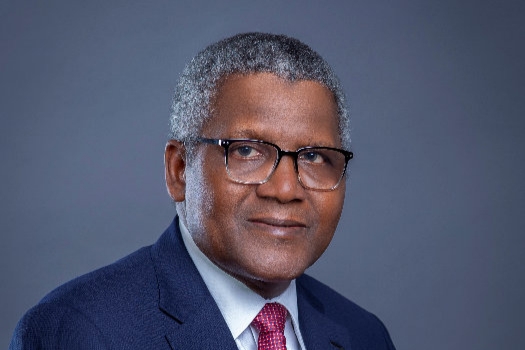
Aliko Dangote’s fortune has jumped sharply following the opening of the initial public offering (IPO) of his Nigerian oil refinery, pushing Africa’s richest man’s estimated wealth above $51 billion.
The Dangote Petroleum Refinery and Petrochemicals IPO opened on September 14, 2026, in what is being described as the largest initial public offering in African capital-market history.
The offer involves 4.1 billion new ordinary shares priced at N525 each, with the company seeking to raise about N2.15 trillion ($1.6 billion). The minimum subscription is 10 shares, costing N5,250.
For Dangote, however, the significance of the transaction goes beyond the money being raised.
The public listing has placed a market value on one of the most valuable assets in his business empire, dramatically increasing the estimated value of his holdings.
Dangote’s fortune crosses $51 billion
Forbes’ real-time billionaire tracker put Dangote’s net worth at about $51.1 billion as of September 14, compared with $28.5 billion in Forbes’ annual Africa billionaires ranking published earlier in 2026.
Nigerian media reports, citing the latest market calculations, have placed his fortune at around $51.3 billion.
That represents an increase of roughly $20 billion from the $28.5 billion figure published in Forbes’ March 2026 annual ranking.
The jump does not mean Dangote received $20 billion in cash from the IPO.
Rather, the IPO has helped establish a much higher valuation for the refinery. Because Dangote retains a substantial majority ownership, the increased value of the company translates into a higher estimated value for his personal stake.
The refinery was valued at roughly $49 billion for the IPO, according to reports based on the offer and prospectus.
Dangote still controls the refinery
Despite opening the refinery to public ownership, Dangote is not giving up control of the business.
The IPO prospectus indicates that his beneficial ownership will remain above 84 per cent after the base offer, while NNPC Limited is also a shareholder.
This means Dangote is effectively bringing outside investors into one of his most important businesses while retaining overwhelming economic control.
It is an unusual structure for an IPO of this scale.
The offering therefore serves two purposes: opening ownership of the refinery to public investors and establishing a publicly observable market value for the asset.
Dangote himself has said the objective is not simply to raise money but to broaden participation in the wealth created by the refinery.
At the IPO opening ceremony in Lagos, he described the transaction as an effort to “democratise wealth creation” and said the Dangote Group already had substantial funding capacity for its expansion plans.
Why the refinery has transformed Dangote’s wealth
The refinery is the product of one of Africa’s largest private industrial investments.
Built at a reported cost of about $20 billion, the facility began refining operations in 2024 and has a current capacity of about 700,000 barrels of crude oil per day.
It has fundamentally changed the scale of Dangote’s industrial empire.
For years, Dangote was primarily associated with cement, sugar, flour and other manufacturing businesses. Dangote Cement remains one of the central pillars of his fortune, with operations across several African countries.
The refinery adds a completely different dimension: energy.
It gives the conglomerate exposure to crude oil refining, petroleum products, aviation fuel and petrochemicals while positioning Nigeria to reduce its dependence on imported refined petroleum products.
The company has also announced plans for a massive expansion.
Its proposed $14.3 billion expansion would increase refining capacity from 700,000 barrels per day to about 1.4 million barrels per day, with completion targeted around 2029.
A profitable asset at a critical moment
The IPO comes as the refinery’s financial performance has improved significantly.
According to figures reported from its IPO disclosures, the refinery recorded a net profit of about $1.82 billion in the first half of 2026, compared with a loss of approximately $282 million during the same period of 2025.
Its secured debt also fell to about $5.67 billion at the end of June 2026 from $6.24 billion at the end of 2025.
These numbers help explain why investors are paying close attention to the listing.
The refinery is no longer simply a huge construction project requiring billions of dollars in capital. It has become a producing industrial asset with significant revenue and profit potential.
What the IPO means for Dangote
The most important financial effect for Dangote is therefore not the $1.6 billion the IPO is expected to raise.
It is the valuation of what he continues to own.
If a company valued at approximately $49 billion is predominantly owned by one person, the owner’s stake can represent tens of billions of dollars in paper wealth.
That wealth can rise or fall depending on the company’s market valuation after listing.
This is why Dangote’s net worth could eventually move considerably higher if investors continue to value the refinery strongly.
Some estimates have suggested his fortune could approach $60 billion once the refinery’s valuation is fully reflected in his holdings. The Guardian reported that a successful flotation could add about $23 billion to his previously estimated $35 billion fortune.
However, such figures should be treated as estimates rather than cash in Dangote’s bank account.
The next test is the stock market
The IPO is only the beginning.
Once the refinery becomes publicly traded, investors will determine how much they are willing to pay for the shares. If the stock rises, the value of Dangote’s retained stake could increase further.
If the shares fall, his paper wealth would decline.
The refinery will also face the challenges common to large energy businesses, including crude supply, foreign-exchange movements, global oil prices, operating costs, debt and competition.
Its planned expansion will require enormous capital and careful execution.
For Nigeria, meanwhile, the listing represents a major moment for the country’s capital market.
For ordinary investors, it offers an opportunity to own a small stake in one of the country’s most prominent industrial assets.
For Dangote, it represents something even bigger: the transformation of a privately controlled industrial project into a publicly valued energy giant—while allowing him to retain control.
The IPO has therefore created a striking financial outcome.
Dangote has not simply raised money by selling shares. He has turned one of Africa’s largest industrial projects into a publicly valued asset, and in the process, the estimated value of his own business empire has surged.

