


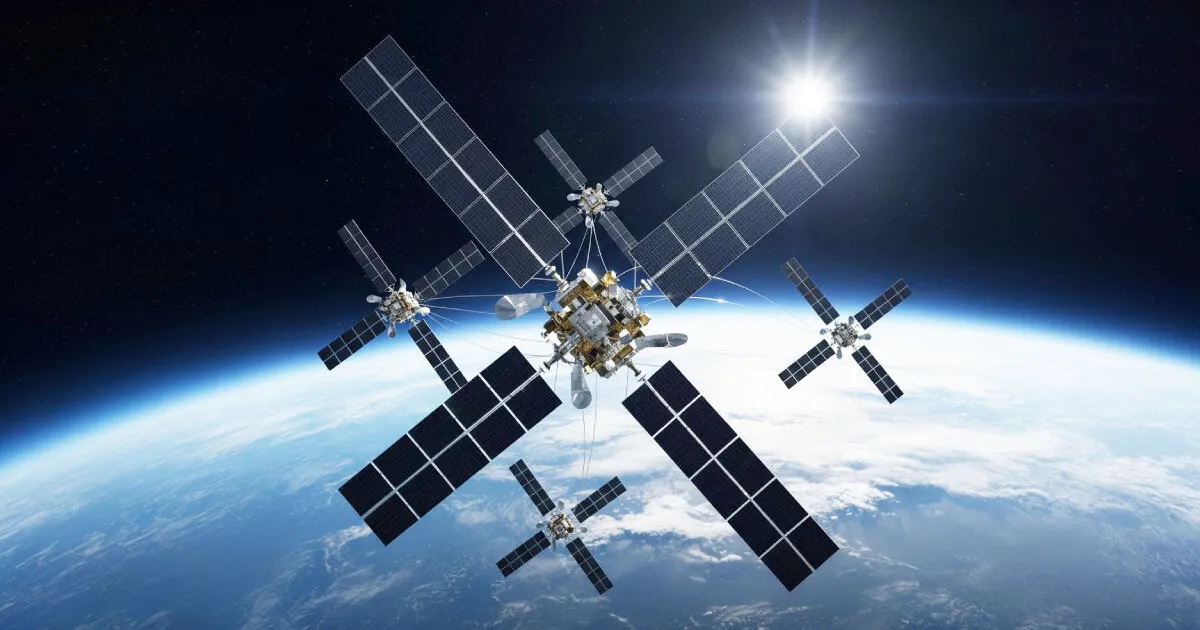
Google is preparing to take a major step towards putting artificial intelligence computing infrastructure in orbit, with an experimental satellite designed to test whether the company’s AI processors can operate in the harsh conditions of space.
The project, known as Project Suncatcher, is Google’s long-term research effort to explore whether networks of solar-powered satellites could eventually provide large-scale computing capacity for artificial intelligence.
Google said its first test mission is scheduled to launch aboard SpaceX’s Transporter-18 rideshare mission, in partnership with satellite company Planet. The prototype will carry Google’s Tensor Processing Units (TPUs) into low Earth orbit to gather real-world data on how the chips perform in space.
The experiment represents an early step towards a much more ambitious concept: interconnected satellites equipped with AI processors that could operate as a space-based computing network.
Unlike conventional data centres on Earth, satellites in low Earth orbit can receive sunlight for much longer periods. Google estimates that satellites could eventually access up to eight times more solar power than comparable solar installations on Earth because they can operate above much of the atmosphere and experience near-continuous sunlight.
The company’s vision is to combine that abundant solar energy with its custom-designed AI chips. In its initial Project Suncatcher research, Google proposed a constellation of satellites carrying TPUs and communicating with one another through high-bandwidth optical links.
Google has already been testing whether its AI processors can survive the conditions they would encounter beyond Earth. The company subjected its TPUs to proton radiation testing at the University of California, Davis, and found that its Trillium processors could withstand a radiation dose greater than what they would be expected to receive during a five-year mission, according to Google.
But putting an AI processor into orbit is only part of the challenge.
Cooling the hardware is one of the biggest engineering problems. On Earth, data centres rely heavily on air or liquid-based systems to remove heat from processors. Space has no atmosphere, meaning there is no conventional airflow to carry heat away.
Google is therefore testing systems involving heat pipes and radiators that can transfer heat from the TPUs and release it into space. The company has already tested these systems inside thermal-vacuum chambers designed to reproduce the conditions the hardware will encounter in orbit.
Communication between satellites presents another challenge. Google’s longer-term concept involves clusters of satellites communicating through lasers. The company says future satellites could carry dozens of TPUs, requiring extremely high-bandwidth connections between neighbouring spacecraft.
Google plans to test two satellites in orbit in 2027 to investigate this inter-satellite communication technology.
The first mission, however, is deliberately limited. Google describes it as a learning mission intended to determine whether its hardware can survive launch, radiation, extreme temperatures and the other physical stresses associated with operating in orbit.
The company has not announced plans to immediately build a commercial space-based data centre. Instead, Project Suncatcher is being presented as a long-term research programme exploring whether space could eventually become a viable location for large-scale AI computing.
The timing is significant as the computing requirements of artificial intelligence continue to expand. Google has been investing heavily in specialised processors and infrastructure, including its eighth-generation TPUs, which are designed for demanding AI training and inference workloads.
If the technical challenges can eventually be solved, Google’s proposed approach could shift part of the infrastructure supporting AI away from traditional terrestrial data centres and towards orbit.
For now, Project Suncatcher remains an experiment. Its first satellite will answer a much simpler question before Google can attempt anything on a larger scale: can Google’s AI chips reliably compute in space?