



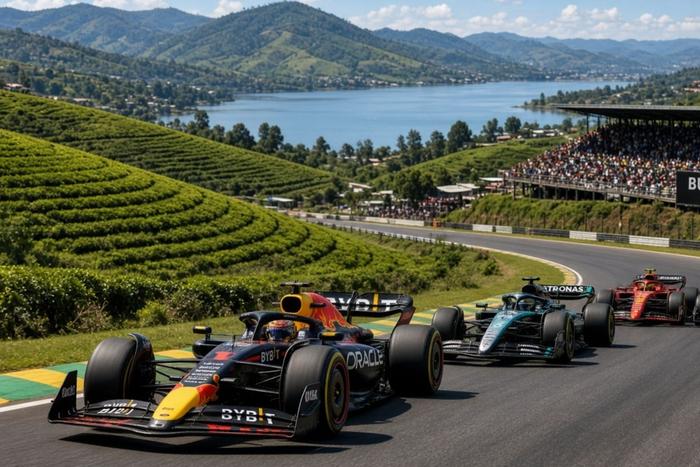
Formula 1 is set to return to Africa for the first time in more than three decades after announcing an agreement with Rwanda to host the African Grand Prix from the early 2030s.
The race will take place at a purpose-built circuit in Bugesera, approximately 40 kilometres south of Rwanda’s capital, Kigali, marking a major milestone for African motorsport and the championship’s global expansion.
The announcement, made on Tuesday, October 13, brings an end to a 33-year absence of Formula 1 racing on the continent. The last Grand Prix held in Africa was the South African Grand Prix at Kyalami in 1993.
The agreement was announced in the presence of Rwandan President Paul Kagame, Formula 1 President and Chief Executive Stefano Domenicali, and FIA President Mohammed Ben Sulayem.
The event will officially be known as the Formula 1 African Grand Prix, presented by Visit Rwanda, positioning the East African nation at the centre of the sport’s long-awaited return to the continent.
The new circuit will be constructed to meet the FIA’s Grade 1 standards, the highest circuit classification required to host Formula 1 races. Its design will take advantage of the region’s natural elevation changes to create a challenging racing experience.
The project brings together former Formula 1 driver Alex Wurz’s Wurz Design and Tilke Engineers and Architects, the firm behind several international racing circuits. The venue is planned as a multipurpose facility capable of hosting other motorsport competitions and major events.
The circuit’s location near the planned Bugesera International Airport is also expected to support tourism, transport and wider commercial development in the surrounding area. However, the inaugural race date has not yet been confirmed, with the event dependent on construction progress and the necessary preparations.
The announcement is particularly significant for seven-time world champion Lewis Hamilton, who has repeatedly called for Formula 1 to return to Africa. Hamilton has previously argued that the championship’s absence from the continent represents a major gap in its global footprint, given Africa’s rich culture, growing audience and potential to develop motorsport talent.
Rwanda’s agreement offers a concrete step towards addressing that gap, creating opportunities for African fans to experience the championship in person and for young people to explore careers in driving, engineering, mechanics and other areas of motorsport.
Beyond the racing itself, Rwanda is positioning the Grand Prix as part of a broader strategy to attract international visitors, investment and major sporting events.
The 10-year agreement is expected to create opportunities across hospitality, aviation, tourism, construction, event management and related industries. Local businesses could benefit from increased visitor spending, while the circuit could provide a platform for skills development and motorsport-related careers.
Formula 1 and the Rwandan government have presented the project as a long-term investment rather than a one-off sporting spectacle. However, the scale of the economic benefits will depend on construction costs, visitor demand, local participation and the project’s long-term financial sustainability.
For East Africa, the development could strengthen the region’s profile as a destination for major international sporting events. It also places Rwanda in a prominent position within a sport that attracts a global audience and significant commercial partnerships.
Formula 1 has previously held World Championship Grands Prix in South Africa and Morocco, but the continent has remained absent from the championship calendar since 1993. Rwanda’s agreement therefore represents a landmark moment in the history of the sport.
With the inaugural race expected in the early 2030s, attention will now turn to circuit construction, infrastructure readiness and the final race schedule.
For millions of African motorsport fans, the prospect of seeing the world’s fastest racing cars compete on home soil is a long-awaited development. For Rwanda, the challenge will be to translate that excitement into a sustainable event that delivers lasting benefits for its people and the wider region.
Africa is officially back on Formula 1’s horizon, and Rwanda is preparing to lead the way.

