


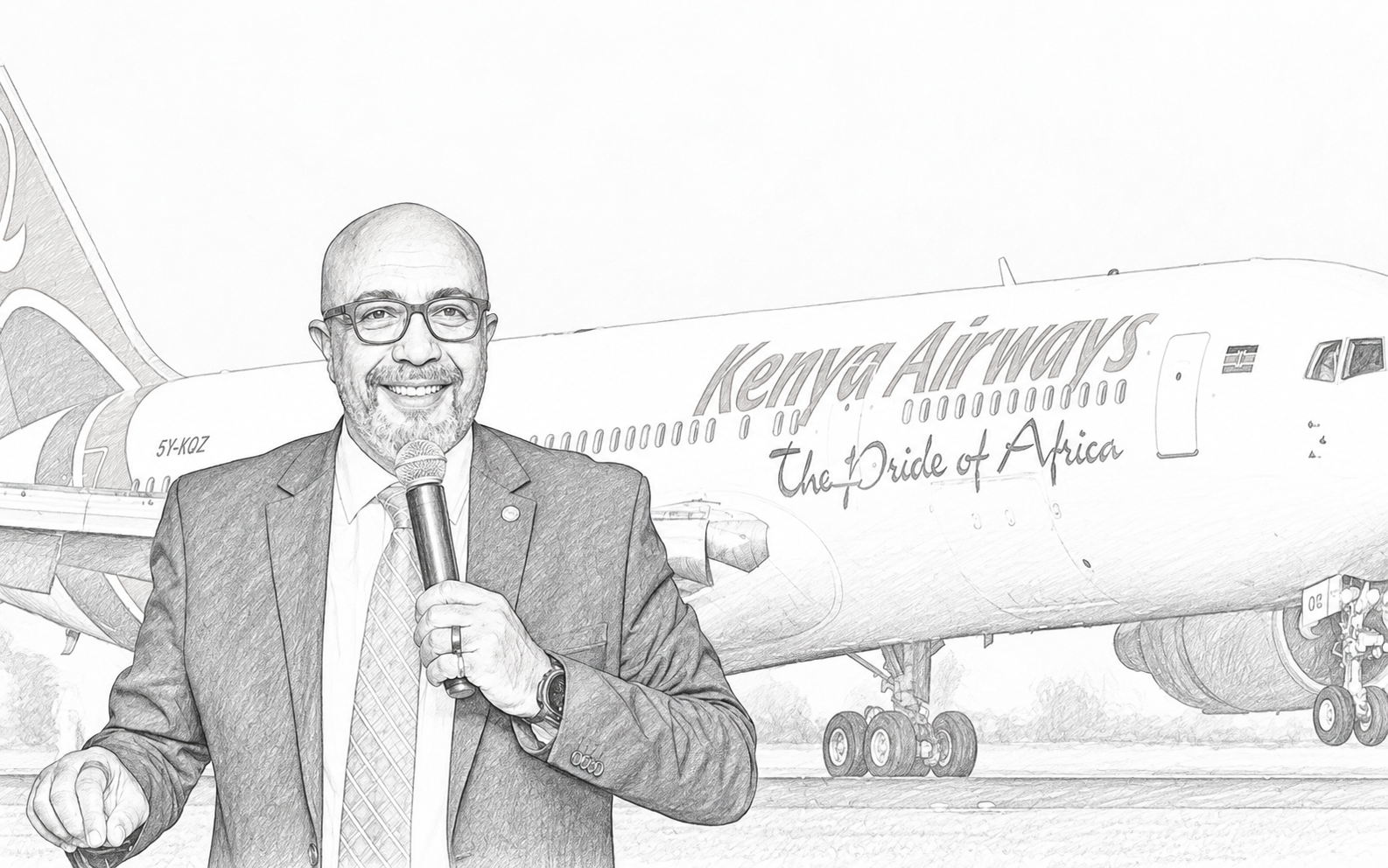
Kenya Airways is attempting another turnaround, but acting chief executive George Kamal knows that the national carrier cannot rely on a single solution to repair its finances.
The airline is dealing with high fuel costs, aircraft shortages, delayed maintenance and a shortage of engines and spare parts — challenges that have constrained its ability to deploy aircraft even as passenger demand remains strong.
KQ reported a pre-tax loss of Sh15.92 billion in the first half of 2026, compared with Sh12.17 billion in the corresponding period last year.
In an interview with Business Daily, Mr Kamal discussed the airline’s plans to return to profitability, expand its fleet, find an investor and restructure its balance sheet.
Question: Why has the turnaround been so difficult?
The airline’s challenge is partly a capacity problem.
Kenya Airways has aircraft that are unavailable because of maintenance requirements, while the global aviation industry is experiencing shortages of aircraft, engines and spare parts.
This means the airline cannot fully take advantage of passenger demand.
At the same time, operating costs have increased sharply.
Fuel remains one of the biggest expenses, with the airline reporting a 72 per cent increase in fuel costs during the first half of the year.
The result is a difficult equation: KQ needs more aircraft to generate revenue, but acquiring and maintaining aircraft requires capital that the airline is already struggling to access.
Question: What is the answer?
Mr Kamal says the airline is looking at aircraft leasing as a bridge while it works towards longer-term fleet expansion.
The strategy would allow KQ to increase capacity without immediately carrying the full cost of purchasing aircraft.
But fleet expansion is only one part of the turnaround.
The airline also needs to strengthen its balance sheet.
KQ is looking for an investor who can provide capital and potentially strategic support as the company restructures its finances.
The search comes at a difficult time for the carrier.
Kenya Airways has accumulated substantial debt over the years, leaving the government and local banks with significant exposure.
A broader restructuring of the airline’s balance sheet is therefore central to its future.
Question: What does growth look like for KQ?
For Mr Kamal, growth cannot simply mean adding aircraft.
The airline needs to improve the efficiency of its operations and ensure that additional capacity generates sustainable returns.
This includes examining routes, aircraft utilisation and operating costs.
The airline also has to navigate competition from Gulf carriers and other international airlines serving Nairobi.
Yet Kenya’s position gives KQ an important advantage.
Nairobi remains a major aviation hub for East Africa, while Kenya is one of the continent’s important tourism and business destinations.
The airline therefore has an opportunity if it can stabilise its finances and improve reliability.
Question: What role will a new investor play?
A strategic investor could provide more than money.
The airline is seeking capital to support fleet expansion and its turnaround, but an investor with aviation expertise could also bring technical knowledge, commercial partnerships and access to wider markets.
KQ’s chairman has confirmed that potential investors from several countries have expressed interest.
For Mr Kamal, the immediate task is to stabilise the airline.
The longer-term objective is more ambitious: to build a financially sustainable national carrier.
That journey will depend on whether KQ can increase capacity, control costs, repair its balance sheet and attract the capital required for growth.
The airline has attempted turnarounds before.
This time, the pressure is to ensure that the strategy produces a different result.