


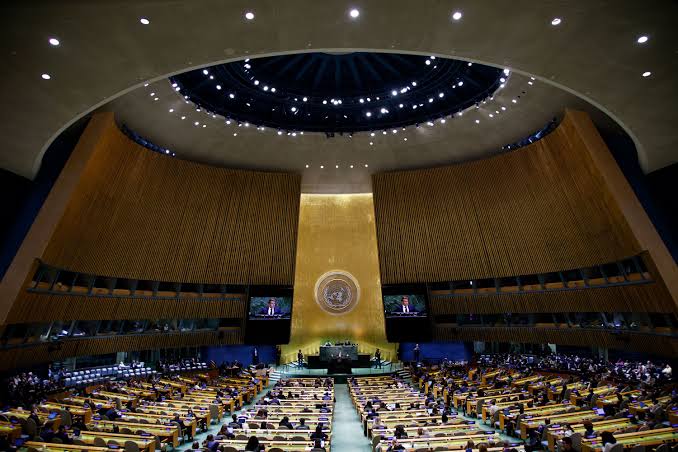
As world leaders gather in New York for the 81st United Nations General Assembly (UNGA 81), Africa arrives with a familiar set of demands: greater representation in global institutions, cheaper and more accessible development finance, climate justice, stronger support for African-led peace efforts and a larger role in the global digital economy.
But there is an important question behind these demands: what does Africa want to achieve beyond another round of speeches, declarations and diplomatic commitments?
That question matters because the continent’s priorities have been articulated repeatedly at previous UN General Assembly sessions, African Union summits, financing conferences and other global forums. The challenge increasingly appears to be less about identifying Africa’s problems and more about converting diplomatic consensus into measurable economic and political outcomes.
The theme of UNGA 81 — “Restoring Trust, Managing Transformation: A United Nations That Delivers for All” — offers an appropriate backdrop. The African Union has identified stronger African representation in global decision-making, reform of international financial institutions, African ownership of peace and security, continental integration and economic transformation among its central messages for this year’s Assembly.
For Africa, therefore, UNGA 81 is not simply another diplomatic gathering. It is an opportunity to connect the continent’s long-standing demands with the economic transformation it is seeking.
From representation to influence
One of Africa’s most persistent issues at the United Nations is Security Council reform.
For decades, African countries have argued that the current structure of the Security Council does not adequately reflect the world’s political realities. The African Union’s Common African Position calls for at least two permanent African seats, alongside five non-permanent seats, with the AU determining its representatives.
The issue has featured prominently in African diplomacy for years. The 2024 Pact for the Future represented an important development, with the UN describing it as containing its strongest commitment to Security Council reform since the 1960s, including measures addressing Africa’s underrepresentation.
Yet the broader lesson from previous UNGA sessions is clear: recognition of Africa’s position is not the same as institutional change.
That distinction should remain central to the African conversation in New York.
The question is no longer simply whether the international community acknowledges Africa’s claim. It is how that acknowledgement translates into a negotiated reform process with concrete milestones.
Africa’s financial architecture may be even more consequential
If political representation determines who gets a seat at the table, financial architecture determines what countries can actually do once they leave the table.
African economies continue to face high borrowing costs, debt pressures and limited access to affordable long-term capital. The UN Office of the Special Adviser on Africa estimates that the continent faces a financing gap of about $1.6 trillion to achieve the Sustainable Development Goals and Agenda 2063.
This makes reform of the international financial system one of the most consequential issues for African countries at UNGA 81.
African governments have already pushed for reforms involving multilateral development banks, sovereign debt, Special Drawing Rights and the broader representation of developing countries within international financial institutions. The Pact for the Future also included commitments on financial architecture reform, development finance and sovereign debt sustainability.
But again, the gap between commitments and implementation is significant.
Africa’s UNGA conversation therefore intersects directly with a much bigger economic question: who controls the cost and availability of capital for Africa’s development?
That question affects everything from infrastructure and manufacturing to healthcare, education, housing and energy.
Climate finance must move closer to the centre of the development conversation
Africa’s climate argument is also evolving.
The continent contributes a relatively small share of historical global greenhouse gas emissions while remaining highly exposed to climate-related shocks. African representatives have consequently continued to push for greater adaptation finance, support for vulnerable countries and implementation of climate commitments.
But climate policy cannot be separated from Africa’s development ambitions.
For many African countries, the debate is not simply about reducing emissions. It is about building resilient agriculture, expanding electricity access, developing transport infrastructure, protecting water resources and creating industries that can generate employment for a rapidly growing population.
The African Union has also placed water and sanitation prominently on its 2026 agenda, reflecting the connection between climate resilience, public health, agriculture, urbanisation and economic development.
The strategic issue for Africa is therefore how climate finance can support productive economic transformation, rather than treating climate action as a separate development category.
Africa’s minerals should become an industrial strategy
Perhaps nowhere is the gap between Africa’s resources and its economic position more visible than in critical minerals.
The continent possesses significant mineral resources required for batteries, renewable energy technologies, electronics and other emerging industries. Yet possessing resources is different from capturing value.
African policy discussions increasingly emphasise local processing, value addition and industrialisation rather than simply exporting raw materials. The UN’s Office of the Special Adviser on Africa has identified value addition, particularly around critical minerals, as part of the continent’s broader push for industrialisation and job creation.
This is where the African Continental Free Trade Area (AfCFTA) becomes important.
A continent-wide market can potentially make it easier for African countries to build regional supply chains rather than operating primarily as exporters of commodities to markets outside Africa.
The AU has repeatedly connected AfCFTA with industrialisation and economic transformation. Its 2026 engagements have continued to emphasise continental integration and stronger African ownership of development.
The UNGA conversation can therefore be viewed through a broader lens: Africa is not merely asking the world to buy its resources. It is increasingly positioning itself as a potential manufacturing, technology and investment partner.
Peace and security remain inseparable from development
No discussion of Africa at the United Nations can ignore conflict.
Sudan, the Sahel, the Great Lakes region, the Horn of Africa and other areas continue to demonstrate the economic cost of insecurity. Conflict disrupts trade, displaces populations, damages infrastructure and diverts public resources away from development.
The African Union has consistently promoted African-led approaches to peace and security, while also seeking predictable international financing for African peace operations authorised by the UN Security Council. Recent AU discussions have specifically highlighted the need for sustainable financing for AU-led peace support operations.
This is another area where previous declarations need to be translated into durable mechanisms.
Peace cannot depend solely on emergency responses after conflicts escalate. Early warning systems, mediation, institutional capacity and post-conflict reconstruction all require predictable financing and long-term political commitment. The AU and UN have also highlighted the importance of accelerating early-warning systems across Africa.
The next frontier: Africa’s digital economy
Artificial intelligence, digital public infrastructure and emerging technologies are likely to become increasingly important to Africa’s position in the global economy.
The continent’s demographic profile makes digital transformation particularly significant. Technology can affect healthcare, education, agriculture, financial inclusion and public administration while creating opportunities for new businesses and jobs.
The AU and UN have already identified digital public infrastructure and responsible AI governance as areas for deeper cooperation.
But Africa’s interest should extend beyond becoming a consumer of technologies developed elsewhere.
Questions around data governance, digital infrastructure, skills, research, computing capacity, intellectual property and technology transfer will influence whether African economies capture significant value from the next technological revolution.
The bigger test for Africa at UNGA 81
Africa has never lacked an agenda.
The continent has Agenda 2063. It has the AfCFTA. It has the Common African Position on Security Council reform. It has repeatedly articulated positions on debt, climate finance, development financing, technology and peace and security.
Previous UN outcomes, including the Pact for the Future, have incorporated several issues that Africa has championed. The 2025 AU-UN annual conference similarly highlighted sustainable financing, Africa’s debt burden, domestic resource mobilisation, the African Credit Rating Agency and digital transformation.
The challenge is implementation.
At UNGA 81, the most consequential African conversation may therefore be less about adding new demands and more about connecting existing commitments to timelines, financing mechanisms, institutional reforms and measurable outcomes.
Africa’s influence at the United Nations will ultimately depend not only on how effectively its leaders speak with one voice, but also on how effectively that voice is connected to the continent’s economic weight, consumer market, natural resources, youthful population and growing technological capabilities.
The objective is not simply for Africa to have a stronger voice in the global system.
It is for that voice to carry greater bargaining power.
And that may be the most important conversation Africa can take to New York in 2026.